

The One-Circuit Kitchen and Its Limitations
The majority of residential kitchens operate on a single lighting circuit controlled by a single switch — overhead recessed lights or a central fixture that provides one level of general illumination for every kitchen activity. This approach addresses the simplest kitchen lighting scenario (bright enough to see what you’re doing) while failing every other scenario: the intimate dinner party, the late-night snack retrieval, the early-morning coffee routine, the task-specific precision of fine knife work.
Kitchen lighting design that serves the full range of kitchen activities requires the same three-layer approach that living room lighting design requires — ambient, task, and accent — applied to the specific functional zones of the kitchen.
Under-Cabinet Lighting: The Task Light Most Kitchens Are Missing
The counter workspace — where food is prepared, vegetables are chopped, and precision cooking tasks happen — is typically the worst-lit area in a kitchen using only overhead lighting. Overhead fixtures cast light on the top of your head and shoulders, creating a shadow on the counter surface directly in front of you — exactly where you need to see clearly.
Under-cabinet LED strip lighting or puck lights, mounted under the upper cabinets and directed down at the counter surface, illuminate the workspace from the front rather than from overhead — eliminating the shadow problem entirely. Installation is DIY-accessible: hardwired fixtures connect to an existing circuit above the cabinet; plug-in versions require only an outlet inside the cabinet. The improvement in counter illumination quality is dramatic and immediately noticeable.
Pendant Lights Over Islands: Decorative and Functional
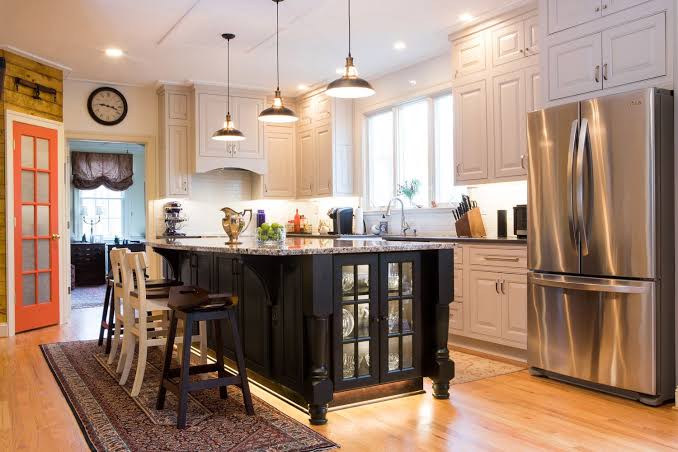
Pendant lights hung over a kitchen island or peninsula serve both decorative and task lighting functions — they provide closer, more directional light for the work surface below while creating a visual focal point that defines the island as a design feature. The installation guideline: pendant bottoms should hang 30–36 inches above a standard 36-inch countertop, providing illumination without obstructing sightlines across the island.
Pendant sizing should be proportional to the island length — a single 6-inch pendant on a 60-inch island looks undersized; three pendants at 10–14 inches each, evenly spaced, is more appropriate. The pendants should relate in scale and style to the kitchen’s other design elements — oversized pendants that dwarf the cabinetry or undersized ones that look like afterthoughts both create visual imbalance.
Recessed Lighting Layout: Avoiding the Mistakes
Recessed downlights in kitchens require deliberate placement to illuminate counters and work surfaces rather than just the center of the room. The most common placement error: a grid of recessed lights centered in the room, which provides good ceiling and floor illumination while leaving counters in partial shadow because the lights are positioned toward the room center rather than over the counter edges.
Counter-aligned recessed lights: position a row of recessed fixtures 18–24 inches from the wall where upper cabinets are mounted, aimed toward the counter below. This creates downlighting that reaches the work surface. Paired with under-cabinet lighting, this arrangement produces genuinely well-lit counters rather than the shadowed surfaces that centered overhead lighting creates.
Dimmer Switches: The Single Upgrade That Changes Kitchen Lighting Completely
Kitchen dimmers are among the highest-return lighting investments available — they allow the same fixture arrangement to serve radically different lighting scenarios. Bright and focused for cooking, dimmed to 30–40% for casual dining at the island, dimmed further for evening ambience, and bright again for cleaning. A kitchen that can only operate at one light level is a kitchen that serves only one of these needs well.
Most LED fixtures are dimmable, but the dimmer switch must be compatible with the specific LED driver in the fixture — not all dimmers work with all LED lights, producing buzzing or flickering when mismatched. Use LED-compatible dimmer switches (labeled as such, or verify compatibility with the fixture manufacturer’s recommendations) and replace older incandescent-rated dimmers when installing LED fixtures.