
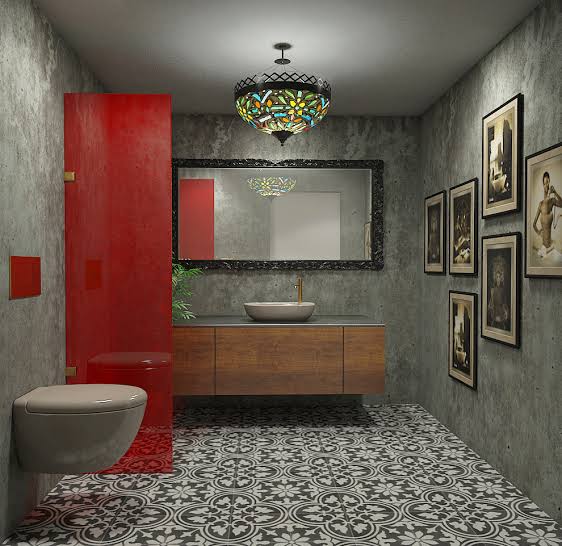

The Flooring Decision Where Looks Are the Least Important Variable
Bathroom floor selection involves more performance variables than any other residential flooring application. The combination of regular water exposure, soap film, humidity, temperature cycling, and the presence of people in bare or socked feet creates a demand profile that eliminates many otherwise attractive options. Materials that perform perfectly in dry areas fail quickly in bathrooms; materials that look less exciting in a showroom often outperform the compelling options by a decade.
The variables to evaluate, in order of consequence: slip resistance when wet, water absorption rate, durability under cleaning products, and then aesthetics.
The Coefficient of Friction: What Slip Resistance Numbers Mean
Slip resistance in tile is measured by the Dynamic Coefficient of Friction (DCOF). The DCOF AcuTest standard for wet, residential floor applications is 0.42 or higher. This number should appear in tile product specifications — if a tile doesn’t list its DCOF, that’s a red flag for wet area applications.
As a practical guide: polished stone and polished porcelain tiles have DCOF values that typically fall below 0.42 when wet, making them inappropriate for bathroom floor applications in areas of water exposure. Matte, textured, and honed finishes have higher DCOF values and are the specification for floor tile in wet areas. This doesn’t mean polished tile is never used on bathroom floors — it means it needs a non-slip treatment or it’s appropriate only in areas that don’t receive direct water.
Small Mosaic Tile: The Shower Floor Standard and Why
Small mosaic tiles — 1-inch to 2-inch hexagons, squares, or penny rounds — are the traditional shower floor tile for a reason that’s purely functional: the required number of grout joints per square foot. More grout joints mean more textured surface, which means higher friction when wet. A 12×12 tile has 2 linear feet of grout joint per square foot; a 1-inch mosaic tile has 24 linear feet of grout joint per square foot.
The grout joints also allow the shower floor to be sloped toward the drain in small increments without requiring cuts at every slope change — small tiles follow compound curves that large tiles can’t. For shower floors specifically, small mosaic tile remains the most functional choice despite the maintenance of more grout to clean.
Luxury Vinyl Plank in Bathrooms: The Caveats That Matter
Luxury vinyl plank (LVP) is marketed for bathroom use and performs well in most bathroom applications — it’s waterproof to the surface, comfortable underfoot, and easy to install. The caveats that matter for bathrooms: LVP is waterproof but not submersion-proof. If water gets under a floating LVP installation through seams at the tub or toilet base — and eventually it does, through a gap in caulk or a toilet wax ring that needs replacement — the water is trapped under the floor where it can cause subfloor damage without visible surface symptoms.
LVP installed with glue-down method (rather than floating) is more appropriate for bathrooms because there’s no gap between plank edges where water can migrate. Floating LVP requires vigilant caulk and seal maintenance at all wall and fixture intersections.
Heated Floor Compatibility: Planning It Into the Material Choice
If radiant floor heating is planned for a bathroom (or may be added in the future), the flooring material choice must account for this before installation. Tile and stone conduct heat efficiently and are fully compatible with radiant systems at any temperature. LVP and laminate are compatible only with systems that maintain low water temperatures — verify the specific product’s maximum temperature rating against the heating system’s output.
The subfloor preparation for radiant heat also affects material choice: electric mat systems installed under tile typically add 3/16 to 3/8 inch to the floor height, which affects transitions to adjacent flooring and the fit of door clearances. Planning the floor height change before installation prevents the retrofit problem of doors that no longer clear the new floor level.