
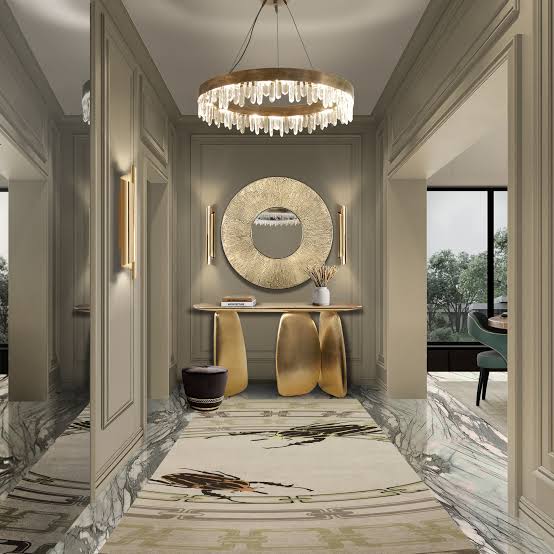

The Space That Sets the Tone for Everything Else
The entryway is the first interior space anyone experiences when entering your home — guests, family members returning home, and you yourself dozens of times each week. Research on environmental psychology consistently finds that the transition experience from outside to inside significantly affects people’s emotional state and perception of the space beyond. An entryway that’s chaotic, dark, or unwelcoming sets a negative tone that persists through the rest of the home visit.
The entryway also performs a specific functional role: it’s where the transition between public and private life happens — where coats come off, shoes are removed, bags are set down, and keys and mail are deposited. When the entryway doesn’t support these rituals effectively, they migrate into the main living space, creating the ‘stuff by the door’ problem that many households struggle with.
The Landing Zone System
The most functional entryway design starts with an explicit landing zone system — a designated place for every category of item that arrives at the door. Keys get a hook or bowl at a specific height by the door. Coats get dedicated hooks or a closet with clear front-of-closet access. Bags get a bench with storage underneath or dedicated hooks at bag-carrying height. Shoes get a concealed tray or pull-out drawer.
When every arriving item has a designated home at the point of entry, the living space is protected from the invasion of entry items. The critical design principle: the designated home for each item must be at the physical location where the item naturally ends up — not where you wish it would end up. If people naturally drop bags on the floor by the door, the bag storage belongs at floor level by the door, not across the room in a dedicated closet.
Lighting the Entryway: Often Inadequate, Easily Fixed
Entryway lighting is among the most neglected in residential design — a single overhead fixture that creates harsh downlighting or a dim space that feels like a transition to be passed through rather than a room to be experienced. Good entryway lighting creates a warm welcome effect that positively affects the emotional experience of entering the home.
Layered entryway lighting: an overhead fixture for general illumination (on a dimmer to allow lower levels in the evening), a table lamp or sconce that creates warm ambient light at eye level, and potentially accent lighting directed at a piece of art or architectural feature. The combination creates a welcoming light environment that the stark overhead-only approach doesn’t achieve.
Mirrors in the Entry: Function and Spatial Effect
A mirror in the entryway serves multiple simultaneous purposes: it provides a final-check surface before leaving the home (everyone uses it, even people who say they don’t), it reflects light and makes the space feel larger, and it creates a visual focal point that makes the entry feel designed rather than transitional.
Entryway mirror placement: at a height that serves the tallest frequent user (the center of the mirror at approximately eye level for the tallest household member), with adequate width to be functional (24 inches minimum for a useful dressing mirror), and positioned to reflect either natural light from a nearby window or the light fixture — not to reflect the wall directly behind the person standing in front of it, which produces a dark background.
The Entryway’s Relationship to the Whole Home
The entryway should be in visual dialogue with the spaces that open from it — using similar materials, colors, or design language that creates continuity rather than the jarring feeling of walking from one design environment into a completely unrelated one. A white-painted board-and-batten entryway that opens into a heavily upholstered Victorian living room creates a disconnect; an entryway in a related material and tone palette creates a sense of arrival rather than confusion.
This doesn’t require identical design — contrast between the entry and main living space can be intentional and beautiful. What it requires is that the contrast feel designed rather than accidental. A dramatic dark-painted entry that opens into a lighter main space creates a beautiful reveal; the same dark entry next to a randomly different space creates an incoherent sequence.