
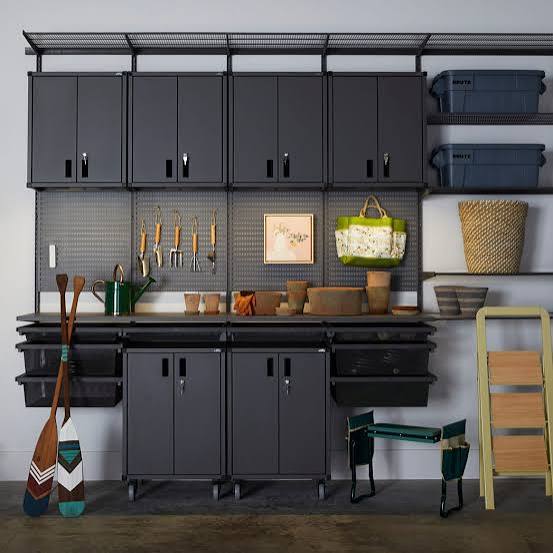

The Seasonal Storage Cycle That Defeats Most Garages
Seasonal items — holiday decorations, camping gear, snow sports equipment, summer furniture cushions, lawn care tools for the off-season — have a specific storage challenge that everyday items don’t: they need to be accessible twice a year (once for retrieval, once for return) but should stay out of the way the other 50 weeks. Most garage storage systems treat seasonal and everyday items the same way, which produces one of two outcomes: seasonal items buried behind everyday items and difficult to access, or seasonal items taking up prime accessible space that everyday items should occupy.
A dedicated seasonal storage strategy — one that accounts for the twice-yearly access pattern and the bulk of seasonal items — creates a garage where getting out the holiday boxes doesn’t require reorganizing the entire space.
Ceiling and High-Wall Storage: The Right Home for Seasonal Bins
Seasonal items belong in the hardest-to-access storage locations — overhead platforms, high wall shelves, or the rearmost positions on deep shelving — precisely because they’re accessed rarely. The premium accessible storage zones (arm height, close to the entry) should be reserved for weekly and daily-use items.
Overhead ceiling storage platforms ($150–$400 for a 4-by-8-foot platform system) that bolt to the ceiling joists provide 32 square feet of storage for items accessed infrequently. Labeled bins of holiday decorations, seasonal sports equipment, and off-season furniture covers live here cleanly, above the car, without consuming any wall or floor space.
The Labeling System That Makes Retrieval Fast
The frustration with seasonal storage isn’t usually accessing the bins — it’s not remembering which of eight identical plastic bins contains what you’re looking for. The 90-second labeling investment at storage time saves 20 minutes of box-opening at retrieval time.
Effective seasonal bin labeling: large-text labels on all four sides of each bin (not just the front), photo labels (a photo of the contents stuck to the outside of the bin) for bins where text doesn’t capture the contents well enough, and a master inventory list (a single document that lists what’s in each numbered bin) stored in a known location. This system seems excessive until the first December morning when you need the tree stand and find it immediately.
Dedicated Zones for Equipment Categories
Large seasonal equipment — kayaks, paddleboards, skis, bicycles, holiday decoration trees — benefits from dedicated storage positions rather than rotating through general storage space. Ceiling-mounted kayak or canoe hoists ($40–$80), wall-mounted ski and snowboard racks, and ceiling-mounted bicycle hooks create permanent, designated positions for large equipment that can be returned to the same position year after year.
Permanent positions for large items reduce the ‘where does this go’ question at storage time and the ‘where did this go’ question at retrieval. The equipment has a home; it always goes there; retrieval requires going to that home and getting it rather than searching the garage.
The Off-Season Audit Built Into the Storage Process
The twice-yearly seasonal swap — retrieving summer gear in spring, storing it in fall — is the natural opportunity for an equipment audit that most people skip. Before storing seasonal items, evaluate each item: Is it in working condition? Will it be used next season? Has anyone outgrown it? Equipment that’s damaged, outgrown, or unused occupies storage space for another year and makes the storage zone harder to navigate.
A simple rule: anything that wasn’t used this season, doesn’t work, or has been replaced gets donated, sold, or discarded before it goes back into storage. Applied consistently, this prevents the slow accumulation of non-functional seasonal items that eventually fills every available storage position in the garage.